Promising nutrients.
Important questions.
VISIVRA features familiar eye-health ingredients. But ingredient research is not proof of results from this exact product. The full label, dosage, and your individual needs should guide the decision—not the marketing.
Jump to the verdictWhat is VISIVRA?
VISIVRA is marketed as a daily vision-support dietary supplement. The reference website describes a blend of carotenoids, plant antioxidants, vitamins, and minerals intended to complement healthy eating and regular eye care. Its central message is nutritional support for visual comfort, retinal wellness, and normal eye function. It is not presented here as a medicine, a substitute for prescription lenses, or a treatment for an eye condition.
This review looks at the ingredients named by the seller, the limits of available evidence, the advertised packages, and the practical questions worth asking before buying. We reviewed the public reference page rather than conducting a laboratory test or a personal trial. We have not independently verified the product’s manufacturing standards, ingredient purity, customer testimonials, or effectiveness. Those distinctions are important when evaluating any supplement promoted for something as valuable as your eyesight.
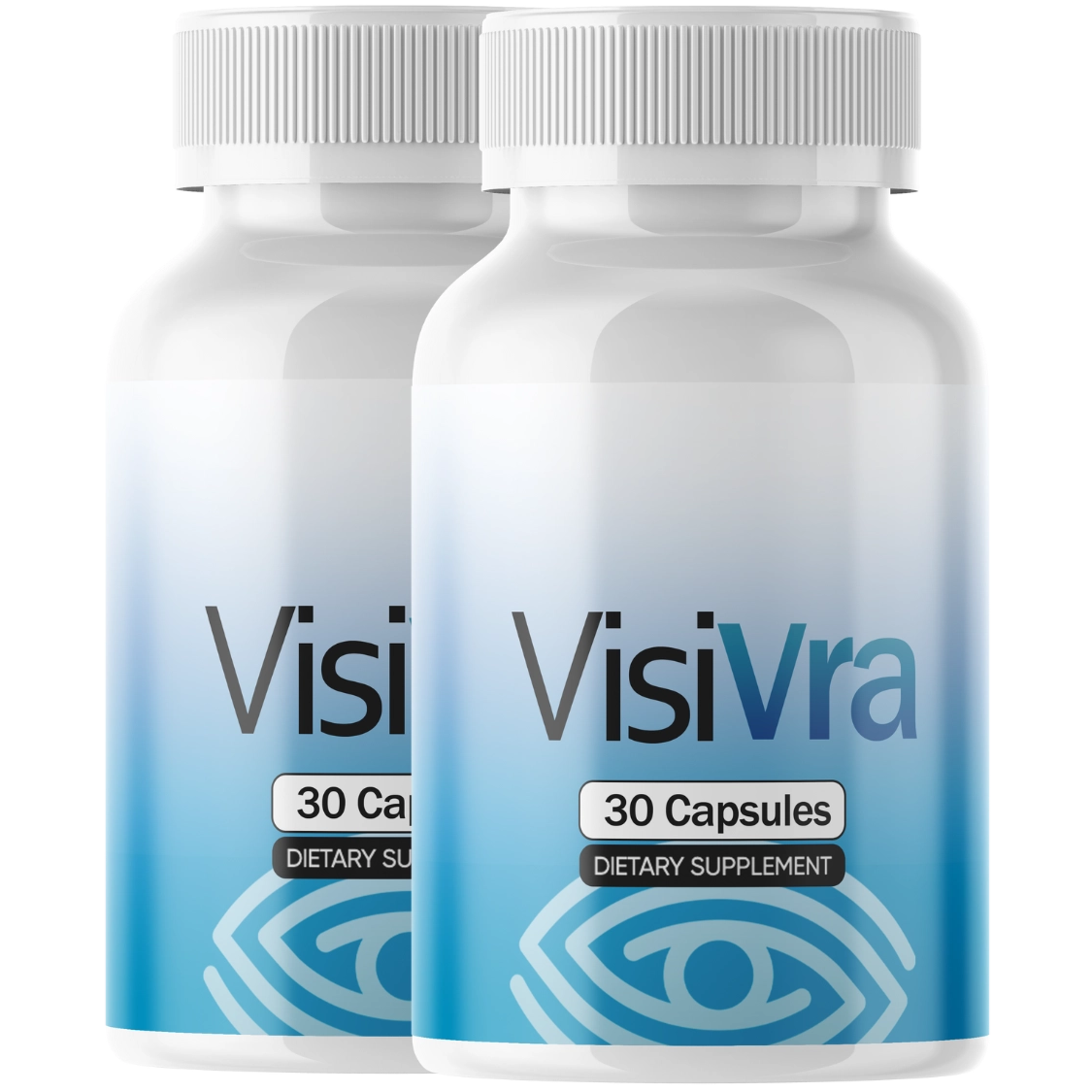
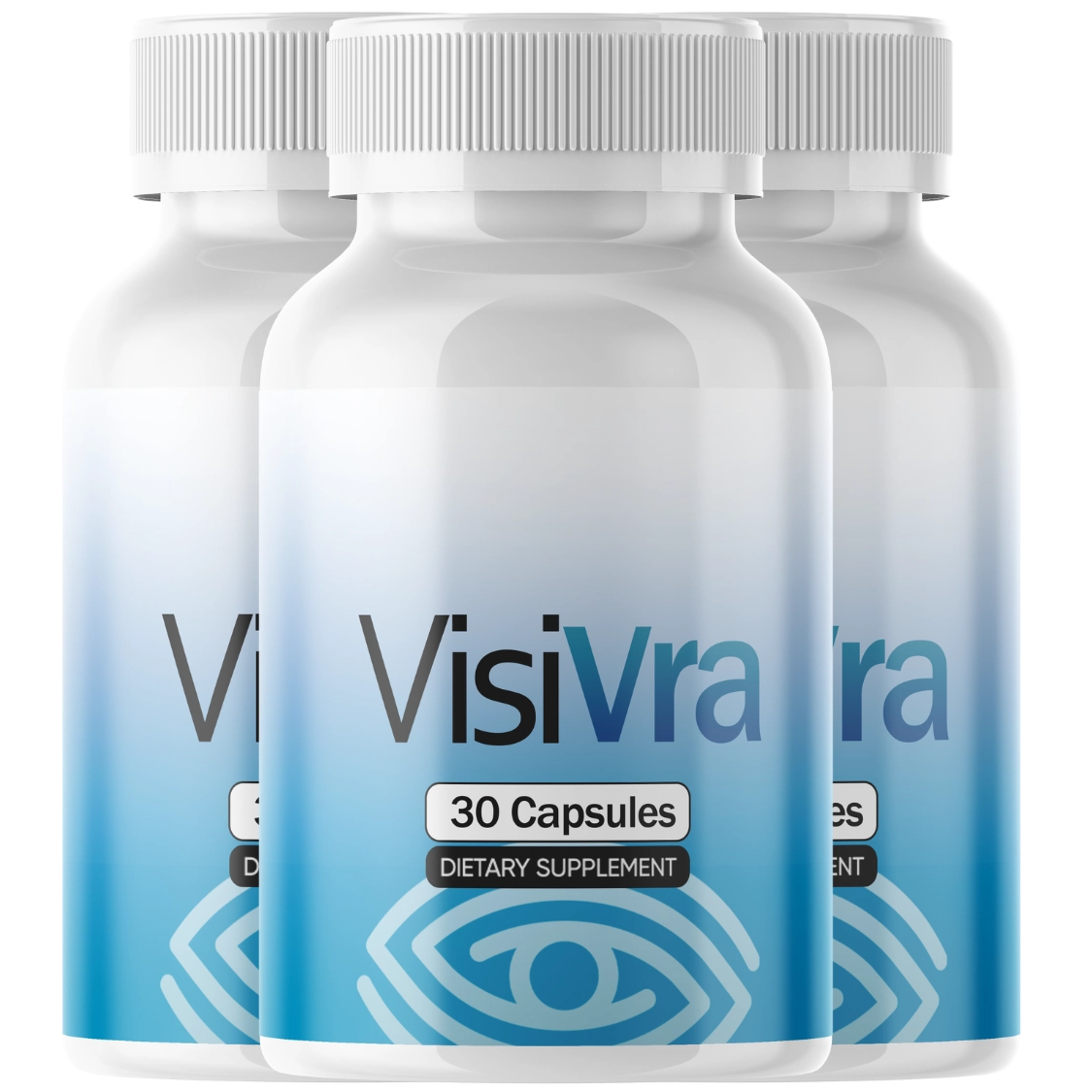
The product images show bottles marked as containing 30 capsules. Meanwhile, the package image describes two bottles as a 60-day supply, three as a 90-day supply, and six as a 180-day supply. Those are seller descriptions, not a verified dosing recommendation. Check the current Supplement Facts panel and directions before use, particularly because a capsule count alone does not establish the right serving size for you.
Inside the VISIVRA formula
Six ingredients highlighted by the manufacturer. Here’s what each brings to the conversation.
Lutein
Lutein is a carotenoid found in leafy greens and concentrated in the macula, the central part of the retina. It contributes to macular pigment, which absorbs some incoming light. Lutein is included in the studied AREDS2 formulation for specific patients with age-related macular degeneration. That does not establish that VISIVRA prevents disease or improves eyesight in healthy adults. Its relevance depends on the amount provided, the complete formula, and the person taking it.
Zeaxanthin
Zeaxanthin works alongside lutein in macular pigment and is naturally present in foods such as corn, peppers, and eggs. The National Eye Institute describes an AREDS2 combination containing both carotenoids, but this evidence concerns a particular formulation and patient group. VISIVRA lists zeaxanthin without publishing a verified amount on the reviewed page. A familiar ingredient name is helpful context, not proof that the product matches clinical research or provides the same outcomes.
Bilberry extract
Bilberry is a berry related to the blueberry and contains anthocyanins, plant compounds with antioxidant properties. It is frequently marketed for eye wellness, particularly night vision. However, reliable clinical evidence supporting those claims is limited. Extract strength, standardization, and dose also matter. The reference page does not supply enough detail to assess those factors for VISIVRA. Treat bilberry as an additional plant ingredient rather than a demonstrated solution for poor night vision.
Astaxanthin
Astaxanthin is a reddish carotenoid associated with antioxidant activity. Research into eye fatigue and related outcomes includes small studies, but the evidence should not be presented as a guarantee of improved screen comfort. Differences in dose, study design, and participant selection limit what can be inferred. The manufacturer includes astaxanthin in its ingredient summary, although the reviewed information does not let us compare the finished product with a specific clinical trial.
Zinc
Zinc supports many normal biological processes and participates in retinal function. It is also part of established AREDS formulations, used under appropriate clinical guidance. More is not automatically better: high zinc intake can interfere with copper status and interact with some medicines. Before combining VISIVRA with a multivitamin or another eye supplement, add up your total intake and ask a pharmacist or clinician whether the combination is suitable for you.
Vitamin A
Vitamin A is necessary for normal vision, including the visual cycle involved in low-light conditions. Correcting a deficiency is different from improving eyesight in someone who already has an adequate intake. Excess preformed vitamin A can be harmful, and pregnancy requires particular caution. The ingredient form and quantity should be checked on the actual label. Do not assume that a vision supplement is safe to stack with other products containing vitamin A.
A note on transparency The reference page names ingredients but does not provide verified numerical doses. Always request the full Supplement Facts label.
What the research does—and doesn’t—say
The strongest familiar evidence in this category comes from the National Eye Institute’s Age-Related Eye Disease Studies, known as AREDS and AREDS2. These studies examined specific nutrient combinations in people with particular stages of age-related macular degeneration. They did not establish that every eye supplement improves vision, that healthy adults need the same formula, or that a product containing a few overlapping ingredients is clinically equivalent.
AREDS2 supplements may help slow progression in eligible people with intermediate AMD or late AMD in one eye. An eye professional should determine whether that guidance applies. The studied combination contains more than the six ingredients highlighted on VISIVRA’s reference page. Without a complete, verified label showing amounts and forms, it is not possible to establish equivalence. Do not replace an ophthalmologist-recommended formulation simply because another product contains lutein and zeaxanthin.
Antioxidant activity is also not the same as a measurable improvement in sight. A laboratory finding, a small ingredient study, and a controlled trial of a finished product answer different questions. The reviewed VISIVRA page does not link to a published trial of the finished formula. Therefore, this review cannot substantiate a claim that VISIVRA itself improves visual acuity, reverses damage, prevents AMD, or reliably resolves eye fatigue.
A sensible interpretation is that several listed nutrients have legitimate roles in nutrition, while product-specific benefits remain uncertain. This distinction avoids two extremes: assuming a supplement must work because its ingredients sound scientific, or assuming every nutritional ingredient is irrelevant. What matters is the actual formula, your nutritional needs, the quality of supporting evidence, and whether a qualified clinician considers supplementation appropriate for your circumstances.
Evidence for an ingredient
is not evidence for every product containing it.
Results: keep expectations realistic
There is no verified VISIVRA-specific timeline for results in the information reviewed. Claims that eyesight will become sharper within days, that glasses will no longer be needed, or that screen-related discomfort will disappear would go beyond the available evidence. Nutritional supplements do not change a prescription or correct common refractive problems such as nearsightedness and astigmatism. A lack of obvious symptoms also does not mean your eyes no longer need professional assessment.
Some people may value a supplement as a convenient way to address an identified dietary gap. Others may notice no subjective change, especially when their nutritional intake is already sufficient. Individual testimonials cannot distinguish a product effect from changing habits, natural symptom variation, expectation, or other treatments. The reference site features positive customer statements, but we have not verified their identities, purchase histories, or experiences and do not use them as clinical evidence.
If a clinician agrees that the product is reasonable for you, discuss what outcome to monitor and when to review your decision. Record the label, dose, start date, and any unwanted effects. Maintain eye appointments and avoid changing prescribed care without advice. For persistent dryness, headaches, blurred vision, or discomfort, an assessment of the underlying cause is more useful than repeatedly purchasing supplements in the hope that one will solve it.
Safety, dosage & who should be cautious
The reviewed reference page does not provide a complete, independently verified Supplement Facts panel or numerical doses for the highlighted ingredients. That is a meaningful limitation, not a minor omission. Before ordering, request a clear photograph of the current label, including serving size, ingredient forms, amounts, inactive ingredients, allergen information, manufacturer details, and any warnings. Follow the actual label only after checking that it is appropriate for your circumstances.
Speak with a healthcare professional before use if you are pregnant, breastfeeding, taking prescription medicines, preparing for surgery, or living with a medical condition. Supplements can interact with medicines and may contribute excessive amounts when combined with other products. Zinc deserves attention when certain antibiotics are used, and vitamin A warrants particular care in pregnancy. A pharmacist can review the full ingredient list alongside your medicines rather than relying on a marketing summary.
A vision-support supplement should never delay urgent care. Sudden vision loss, new flashes, a curtain-like shadow, severe eye pain, or a sudden increase in floaters require prompt medical assessment. These are not symptoms to monitor while waiting for a supplement to work. Children should not be given an adult product without qualified advice. If unwanted effects appear, stop using it and seek guidance rather than increasing the dose or continuing solely to finish a bottle.
The everyday habits that still matter
Eye wellness is broader than what comes in a bottle. A varied diet including vegetables, fruit, and other nutrient-rich foods provides a foundation for overall health. Leafy greens supply lutein, while different foods contribute vitamin A precursors, zinc, and other nutrients. A supplement may be considered for an individual need, but it does not reproduce the full benefits of a balanced dietary pattern or make routine eye examinations unnecessary.
For screen-related discomfort, consider the practical environment: regular breaks, deliberate blinking, comfortable lighting, an appropriate viewing distance, and an up-to-date prescription. Dry-eye symptoms may require an individualized assessment. Outdoor UV protection, avoiding smoking, and managing conditions such as diabetes are also relevant to long-term eye care. These steps address important risks and daily demands that a nutrition product alone cannot correct, even when its ingredients are well chosen.
VISIVRA pricing & packages
The advertised options, without the guesswork. All prices below are in USD.
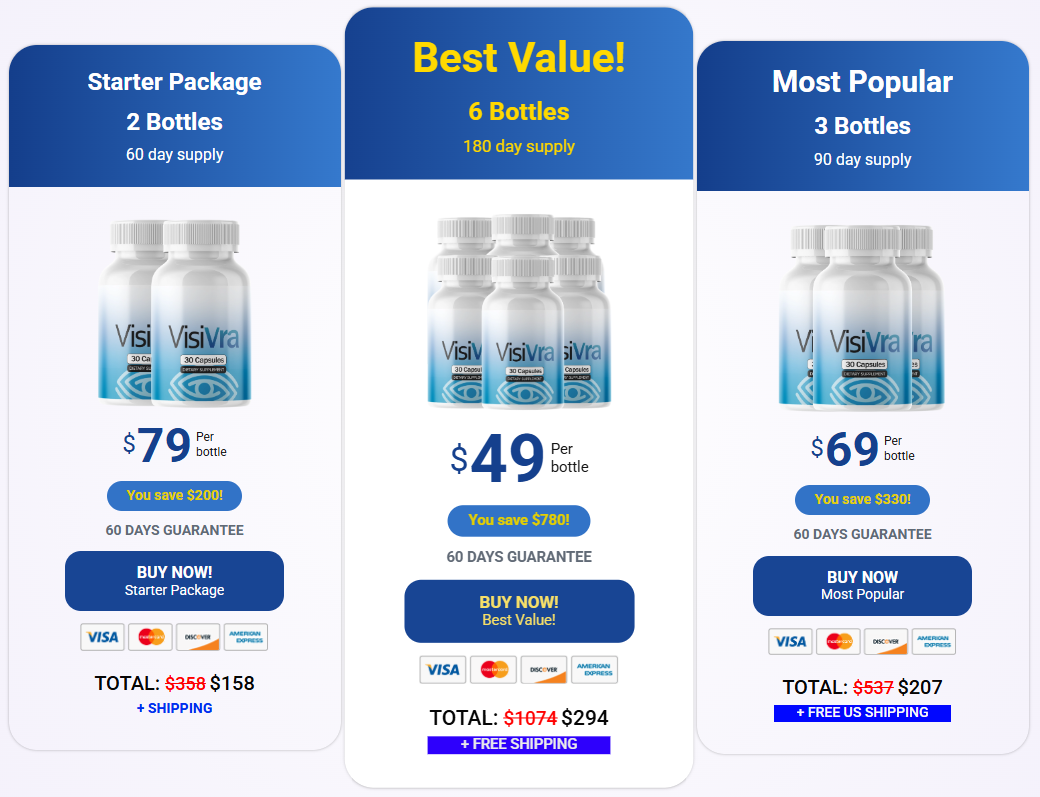
The reference image lists three purchase options in US dollars. The starter package contains two bottles at $79 per bottle, giving a displayed total of $158 before shipping. The three-bottle package is labeled most popular and lists $69 per bottle, or $207 total, with free shipping advertised. The six-bottle package is labeled best value and lists $49 per bottle, or $294 total, also with free shipping advertised.
The lowest per-bottle price requires the largest upfront spend. That can be less appropriate for a first purchase when suitability, tolerability, or satisfaction is still unknown. The source graphic includes crossed-out totals and savings claims; we have not verified the historical prices behind those comparisons. We display the advertised payable totals without presenting the promotional savings as independently established facts. Confirm all current prices, taxes, shipping terms, and availability on the order page.
View the original pricing image
Before you order: a transparent checklist
Start with the full label, not the biggest discount. A useful supplement comparison considers ingredient amounts, formulation, independent testing evidence, suitability, and total cost. If a seller claims quality testing, request the actual documentation and identify what was tested. Manufacturing language or a quality icon does not establish clinical effectiveness, and it does not show that a product has been approved to treat an eye disease.
Next, read the current checkout terms. Confirm whether the purchase is a one-time order, which destinations are served, how shipping and tax are calculated, and what customer support is available. The reference pricing graphic advertises a 60-day guarantee, but the reviewed page does not establish the full return procedure, exclusions, or the date from which that period starts. Verify those details before treating a guarantee as equivalent to a risk-free purchase.
Keep a copy of the order confirmation and the terms shown when you purchase. Avoid buying through unrelated listings simply because they reuse the same bottle image. Every order button on this page leads to the reference site’s designated order page. That destination is provided for convenience; it does not constitute independent verification of the seller, the checkout provider, or the product. If important information remains unavailable, waiting is a reasonable choice.
Our honest verdict on VISIVRA
VISIVRA brings together several recognizable eye-nutrition ingredients, and the reference website makes it straightforward to see the advertised bundles. Lutein, zeaxanthin, zinc, and vitamin A have established nutritional relevance, while bilberry and astaxanthin add an antioxidant-focused angle. For an adult exploring nutritional support, the ingredient list is a starting point for a conversation, not a sufficient basis for assuming the product will improve vision.
The biggest limitation is transparency around the finished formula. Without verified doses, a complete label, accessible testing documentation, and product-specific research, we cannot determine whether VISIVRA offers a meaningful advantage over other options. We also cannot validate the seller’s testimonials or quantify likely results. Anyone seeking treatment for diagnosed eye disease should prioritize professional guidance and any specifically recommended formulation instead of selecting a product on marketing claims alone.
Our conclusion is cautious rather than promotional: consider VISIVRA only after reviewing its current label, confirming the total purchase terms, and checking suitability with a clinician when needed. Do not buy expecting restored eyesight, an immediate effect, or a replacement for regular eye care. If the manufacturer supplies clearer formulation and testing information, that would make the product easier to evaluate. Until then, informed questions matter more than the promise of a discount.
Make an informed choice.
Keep your eye care first.
A few more things worth knowing
What is VISIVRA used for?
The seller markets VISIVRA for daily nutritional support of eye wellness, visual comfort, and normal vision. It is a dietary supplement, not a treatment for an eye disease. Its suitability depends on your health, diet, medicines, and the complete formulation. Seek professional advice if you have symptoms or a diagnosed condition.
Can VISIVRA improve eyesight or replace glasses?
We found no linked clinical trial of the finished VISIVRA formula on the reviewed reference page. It should not be expected to correct a prescription, reverse vision loss, or replace glasses. Nutrient research does not establish those outcomes for this product. An eye examination is the right starting point for changing or blurred vision.
Is VISIVRA the same as an AREDS2 supplement?
That has not been established. AREDS2 refers to a specific studied combination and particular AMD circumstances. Sharing lutein, zeaxanthin, or zinc with that formulation does not demonstrate equivalence. Compare the complete label with your ophthalmologist’s recommendation, rather than assuming any vision-support product provides the same ingredients, doses, or evidence.
How much does VISIVRA cost?
The reference pricing image shows two bottles at $79 each ($158 total), three at $69 each ($207 total), and six at $49 each ($294 total), in USD. It advertises free shipping for the three- and six-bottle bundles. Prices, taxes, delivery charges, and availability should be confirmed at checkout before you pay.
Is there a money-back guarantee?
The reference image advertises a 60-day guarantee. We have not independently verified the full policy or refund process. Read the current terms for deadlines, return requirements, eligible orders, and any excluded costs before purchasing. Contact the seller if the instructions are unclear, and keep the policy with your order confirmation.
How should I take VISIVRA?
Use only the current product label’s directions after checking suitability. The public information reviewed does not establish a verified serving size or exact ingredient doses. A bottle image or advertised supply length is not enough to determine dosage. Ask for the complete Supplement Facts panel and consult a pharmacist if you take other supplements or medicines.
How we approached this review
An additional consideration is how the seller describes visual comfort. This is a broad wellness phrase, not a standardized diagnosis or a clearly defined outcome. Discomfort can arise from dry eyes, an outdated prescription, prolonged close work, environmental irritation, or other causes. Unless a study specifies the symptom, measurement, participants, and comparison group, an improvement claim is difficult to evaluate. Ask what exactly was measured and whether that evidence concerns the marketed formula rather than an isolated ingredient.
Value also means more than cost per bottle. A lower advertised price is not good value if the product duplicates nutrients you already take, lacks the information needed for a safe choice, or creates an expense without a defined purpose. A conversation with an eye professional can help identify whether nutritional supplementation is relevant at all. That conversation may lead to a particular formula, a dietary change, or no supplement. Each can be a reasonable outcome when it matches your actual needs and evidence.
This page is an editorial review, not the manufacturer’s website. The assessment uses the public VISIVRA reference page for product descriptions and package information, and established health organizations for general ingredient context. We distinguish what the seller says from what independent research supports. No physician has evaluated individual readers through this page, and no personalized medical recommendation is offered. The purpose is to help you identify useful questions before making a purchase.
We did not purchase or personally test VISIVRA, inspect a manufacturing facility, analyze a bottle, or authenticate customer reviews. We have deliberately avoided assigning a star rating because a numerical score could imply a level of testing that has not occurred. The review also avoids invented before-and-after results, unverified endorsements, and disease-treatment claims. References provide background about nutrition and eye care; they should not be mistaken for clinical validation of the VISIVRA brand.
Product information and checkout terms can change after publication. The pricing image is reproduced from the reference site, and its displayed amounts are explained in the pricing section. Confirm the current label and terms directly with the seller. If you encounter a difference between this review and the current checkout, rely on the current written terms and ask the seller to clarify the discrepancy before paying. Medical decisions should be discussed with a qualified professional who knows your circumstances.